TL;DR
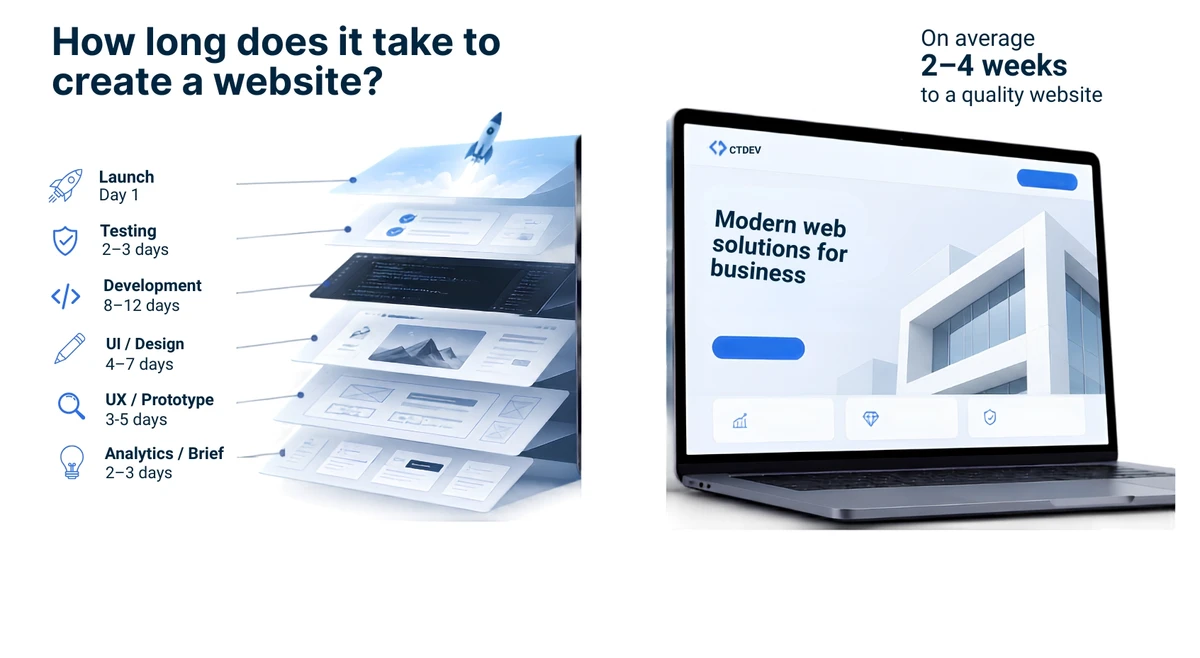
- A simple one-page website can be built in 2–5 working days. A full multi-page website takes 1–3 weeks. A complex online store can take 4–8 weeks.
- Many developers quote 8–12 weeks but deliver in 4–6 months — the gap is usually caused by bloated process, unnecessary technology setup, and unclear scope, not by the work itself being hard.
- The biggest factor in your timeline isn’t the developer’s speed — it’s how quickly you can provide your content (text, photos, logos) and give feedback on drafts.
- Ask for a timeline broken down by phase, not just one number. A developer who can tell you “consultation is 2 days, build is 4 days, launch is 1 day” is one who has a real process.
You asked three developers how long it would take to build your website. One said “two weeks.” Another said “eight weeks.” The third said “three months.” They’re all looking at the same project. So who’s telling the truth? And why do so many projects that start with “8 weeks” end with you still waiting at month 5?
Why “8 Weeks” So Often Becomes 6 Months
The gap between the quoted timeline and the delivered timeline is rarely about dishonesty. It’s about five factors that compound on each other — and most developers don’t explain them upfront.
Scope creep. You start wanting 3 pages. Midway through, you add a blog, a photo gallery, and a booking form. Each addition adds days or weeks. This is the number one timeline killer, and it’s often driven by the client, not the developer. A good consultation locks the scope before building starts — but even then, ideas happen mid-project. The question is whether those ideas wait for a phase 2 or derail the current timeline.
Technology overhead. Some website systems require extensive setup before any design work begins: configuring a database, installing security plugins, setting up templates, testing for conflicts between components. This setup can eat 1–2 weeks before a single page is designed. You’re paying for setup time that produces nothing visible — no pages, no content, no progress you can review. It’s invisible work that feels like stalling because, from your side, it is.
Developer bandwidth. You’re rarely the only client. If your developer is juggling 5 projects, your “8 weeks” of actual work is spread across 16 weeks of calendar time. This isn’t dishonesty — it’s scheduling math. But it’s rarely explained upfront. A developer who says “8 weeks” might mean “8 weeks of work, scheduled over 16 weeks of calendar time because I have other clients.” Ask how many projects they run simultaneously.
Content delays. The developer can’t build pages without your text and photos. If you take 3 weeks to send your content, the project takes 3 weeks longer — and most developers won’t nag you about it because they don’t want to seem pushy. This is the factor most people overlook, and it’s the one you have the most control over.
Revision rounds. “I don’t like the header.” “Can the colors be different?” “Actually, let’s change the layout.” Each revision cycle adds 2–5 days. Three rounds of revisions = nearly two extra weeks. Revisions are normal and expected — but unbounded revisions are a timeline killer. A good process limits revisions to 2 rounds and keeps the project moving.
Related: How Much Does a Website Cost in 2026? — timeline gaps drive cost gaps. The longer your project runs, the more you pay.
What Actually Determines Your Timeline
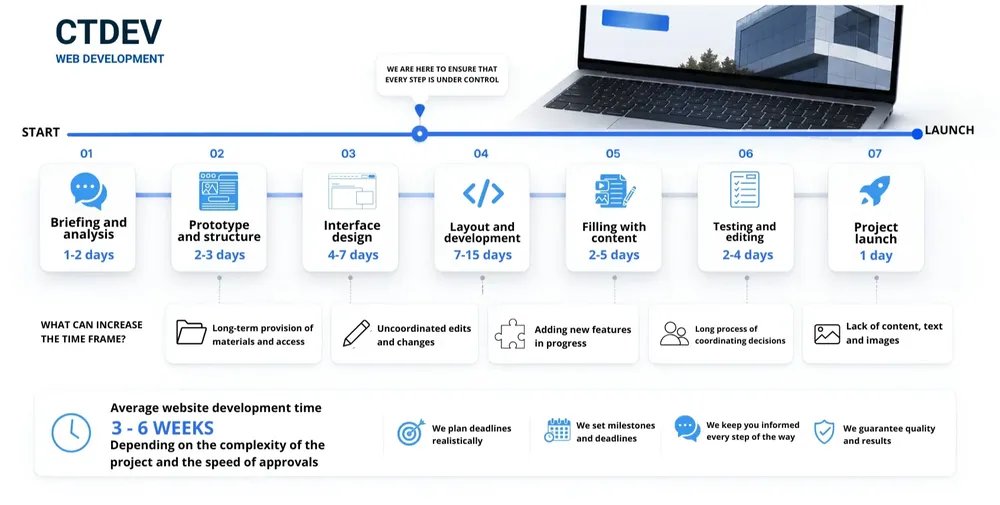
Four factors, and only one of them is about the developer:
Size of the site. 1 page vs 5 pages vs 20 pages. More pages means more design work, more content to write or format, and more testing. A one-page site has one layout to perfect. A ten-page site has ten.
Complexity of features. A contact form is simple — a few hours of work. A booking system, online payments, or user accounts add significant time because each feature needs its own design, testing, and security setup. The difference between “a page with a form” and “a page with a working payment system” can be weeks.
Content readiness. If your text, photos, and logo are ready on day 1, the project moves at full speed. If you’re still writing your About page in week 3, nothing moves. This is the factor most clients underestimate. “I’ll get the content to you soon” is the most common phrase in website project delays.
Technology choice. Some approaches require setting up servers, databases, and security software before any design starts. Others skip all that and go straight to building pages. The technology your developer uses can add or remove a week of setup time before you see anything. Why Your Website Doesn’t Need to Be Complicated explains why simpler technology isn’t just faster — it’s also cheaper and more reliable.
Real Timeline Ranges
No “it depends” without numbers. Here are honest ranges for each type of site.
One-page website (landing page): 2–5 working days. One page, one purpose, focused content. The build itself is fast — most of the time is spent on consultation, content refinement, and your feedback. If your content is ready and you respond quickly, 2 days is realistic. If you need help writing the content or want multiple revision rounds, expect closer to 5.
See our landing page service for how this works in practice.
Multi-page website (5–10 pages): 1–3 weeks. Home, services, about, contact, maybe a blog. Each page needs its own design, content, and review. The range depends on how many pages and how quickly you provide content and approve drafts. A 5-page site with content ready can be done in a week. A 10-page site with content being written as you go can stretch to three.
See our multi-page service for details.
Online store (e-commerce): 4–8 weeks. Product pages, shopping cart, payment processing, inventory, shipping integration. This is genuinely complex work and the timeline reflects that. Anyone quoting “1 week” for a full online store is either lying or planning to do a bad job. A small store with 10 products and a simple payment setup is closer to 4 weeks. A large store with hundreds of products, multiple shipping zones, and inventory sync is closer to 8 — or more.
Custom web application: 8+ weeks. Anything with user accounts, dashboards, custom databases, or integrations with other software. This is software development, not website building, and the timeline is closer to software timelines. If your project is in this category, you need a software developer, not a website builder — and the timeline conversation is a different one.
These ranges assume your content is ready and your feedback is prompt. If you take 2 weeks to send your photos, add 2 weeks to every range above. The developer’s speed is only half the equation — your responsiveness is the other half.
The 3-Phase Process: Consult, Build, Launch
A developer who can break their timeline into phases is one who has a real process. Here’s what each phase looks like and how long it takes.
Phase 1: Consultation (1–3 days)
You fill out a short web form — your goals, what you need the website to do, examples of sites you like. We review your answers, agree on the page list, the content structure, and the timeline. You get a written plan before any building starts. No phone calls required — the entire consultation can happen through the form and message thread.
This is where scope is locked. A good consultation prevents the scope creep that turns 8 weeks into 6 months. If you’re comparing developers, ask what their consultation includes — a developer who skips this step is one who’ll be “figuring it out as they go,” which is the most expensive way to build a website.
See how our consultation works →
Phase 2: Build (2–10 working days, depending on size)
This is where the pages are actually built. Design, layout, text formatting, mobile optimization, contact forms — all assembled into a working draft you can review.
Why our build phase is short: we don’t spend the first week setting up servers, databases, and plugins. The technology we use skips that entire layer — pages are built directly, like writing a document, not like assembling a machine with moving parts. This isn’t a shortcut — it’s a fundamentally different approach that eliminates unnecessary setup work. Why Your Website Doesn’t Need to Be Complicated explains this in detail.
We won’t pretend every build takes “days.” A 15-page site with custom features takes longer than a 3-page site with standard content. The build speed advantage is real but proportional to the project size. We’ll be specific about your timeline during consultation, not after you’ve signed.
See how our build process works →
Phase 3: Launch (1 day)
Your site goes live on your domain. We set up hosting, connect your domain, and run a final check on all pages. You get a live website and a handoff document.
With modern deployment, this is near-instant — no waiting for server settings to update across the internet, no server configuration, no security patches to apply. Free Website Hosting: What’s the Catch? explains how hosting works without traditional server setup.
See how our launch process works →
Why Some Developers Are Faster Than Others
The speed difference between developers isn’t about typing faster or working longer hours. It’s about technology and process.
Technology choice. Traditional approaches use a content management system (CMS) — software that runs on a server, stores your content in a database, and assembles pages on the fly each time a visitor loads them. WordPress is the most common example. Setting up a CMS involves installing the software, configuring a database, choosing and customizing a theme, installing plugins for extra features, and testing that none of those plugins conflict with each other. This setup alone can take a week or more before any page is designed.
We build static websites — pages that are pre-built files, not software running on a server. No database to configure, no plugins to conflict, no server to secure. The page-building starts on day 1, not day 8. This isn’t “better” in every scenario — a CMS makes sense if you need to update content daily without technical help. But for most websites that change a few times a year, the CMS setup is unnecessary overhead that adds time and cost without adding value.
Process discipline. A developer with a defined process — consultation, build, launch, with clear milestones and deadlines — will always be faster than one who “figures it out as they go.” Process eliminates the back-and-forth, the unclear expectations, and the mid-project redesigns that eat calendar time. A developer who can’t describe their process probably doesn’t have one.
Client bandwidth. A developer who takes on 2 projects at a time finishes faster than one juggling 8. This isn’t about skill — it’s about availability. If your developer is spread across 8 projects, your 5-day build might take 3 weeks of calendar time because you’re waiting in a queue. Ask how many projects they run simultaneously before signing.
Related: Wix vs Squarespace vs Hiring a Developer — the timeline tradeoffs of building it yourself vs hiring someone who builds for a living.
How to Keep Your Project on Track
The developer controls half the timeline. You control the other half. Here’s what you can do to keep things moving.
Have your content ready before the build starts. Text for each page, your logo, and any photos you want to use. This is the single biggest factor in your timeline. If content is ready on day 1, the project moves at full speed. If it’s not, nothing moves — no matter how fast the developer is.
Write your own text or hire a writer before hiring a developer. Many developers aren’t professional copywriters. If you expect them to write your content, it adds time and the result may not represent you the way you want. Write it yourself, or hire a copywriter, and hand the developer finished text. The build goes faster, and the content is better.
Limit revisions to 2 rounds. Decide what you want, give clear and specific feedback, and resist the urge to redesign after seeing the first draft. Each revision cycle adds days. Two rounds of focused revisions is enough for almost any project — if you’re on round 5, the problem isn’t the design, it’s the scope.
Respond within 48 hours. When the developer sends you a draft or asks a question, reply quickly. A project where the client responds in 2 days vs 7 days has a very different timeline — and the difference compounds over multiple rounds of feedback.
Lock the scope before building starts. Don’t add pages or features mid-project. If you need something new, save it for a phase 2 after launch. Every mid-project addition pushes the launch date back and often breaks the flow of work already in progress.
DIY Builders: Faster to Start, Slower to Get Right
Tools like Wix and Squarespace let you start building immediately — you can have something live in an afternoon. But “live” and “good” are different things. Getting a DIY site to look professional, load fast, and rank on Google typically takes weeks of tweaking, and the result is still limited by what the platform allows.
Hiring a developer takes longer to start — there’s a consultation, planning, and a build phase — but the finished site is done right the first time. The total calendar time is often similar. The difference is in the outcome: a site built for you vs a template filled in by someone who’s also got other work to do.
This isn’t a knock on DIY tools. They’re genuinely useful for testing ideas or launching something simple with no budget. But if you’re comparing “I can do it myself in 2 weeks” vs “a developer takes 2 weeks,” the comparison isn’t the timeline — it’s what you get at the end of it.
The 30-Second Timeline Readiness Check
Before you start a website project, answer these five questions:
- I know what pages I need and what each one should say
- I have my text, photos, and logo ready — or a plan to get them before the build starts
- I can respond to drafts and questions within 48 hours
- I’ve decided what features I need (contact form, booking, payments) and won’t add more mid-project
- I’m ready to limit revisions to 2 rounds of focused feedback
If you checked “no” on two or more, your project will take longer than the ranges above — not because of the developer, but because of preparation. Fix those before you start and your timeline shrinks dramatically.
FAQ
Can a website be built in one day?
Yes, for a simple one-page site — if you have your content ready and the design is straightforward. A landing page with a clear purpose, your text, and your photos can be built and launched in a single working day. But “one day” assumes you respond quickly and don’t need major revisions. A 5-page site in one day is not realistic — anyone promising that is cutting corners you’ll pay for later.
Why did my developer say 6 weeks and it took 5 months?
The most common reasons: the scope grew beyond what was originally discussed, you took longer to provide content than expected, the developer was working on multiple projects simultaneously, or the technology they used required more setup and debugging than planned. Ask your developer for a phase-by-phase breakdown and a written timeline. If they can’t give you one, that’s a red flag — not because they’re slow, but because they don’t have a process. How Much Does a Website Cost in 2026? covers how timeline gaps also drive cost gaps.
Is a faster build a lower-quality build?
Not necessarily. Speed comes from technology choice and process discipline, not from cutting corners. A developer who skips unnecessary setup — server configuration, plugin management, database tuning — isn’t doing less work. They’re doing the right work. The danger sign isn’t speed; it’s vagueness. A fast developer who explains exactly what they’ll do, in what order, and by when is reliable. A slow developer who can’t explain the timeline is the real risk.
What if I need my website launched next week?
Tell the developer upfront. A simple landing page can realistically be built and launched in 2–3 working days if your content is ready. A multi-page site in one week is possible but tight — it requires fast feedback from you and a developer who isn’t juggling other deadlines. Be honest about your deadline and ask if it’s achievable before signing anything. A good developer will tell you the truth, even if it’s “that’s not enough time for what you need.”
Bottom Line
The honest answer to “how long does it take to build a website” is: a few days for something simple, a few weeks for something complete, and a few months only if your project is genuinely complex. If your developer can’t break their timeline into phases and explain each one, that’s the real red flag — not the total number.
Want to know exactly how long your website would take? Our process is transparent — consultation, build, and launch, each with a clear timeline. See our process →
Ready to start? Get a free quote →