TL;DR
- Social media platforms are rented space — you don’t own your followers, your content reach, or your account. The platform can change the rules overnight.
- Instagram’s organic reach has dropped from ~16% to under 2%, meaning almost no one sees your posts unless you pay for ads.
- A website is the only digital asset you fully own and control — your content, your customer data, and your email list can’t be taken away by a platform.
- A website is a hub with multiple traffic sources (Google, direct visits, referrals, social links). If one channel drops, the others keep flowing. Bet everything on one platform and you have no fallback.
- Google reaches people with buying intent — they’re actively searching to hire. Instagram reaches people scrolling for entertainment. Different audiences, different value.
- You don’t have to choose: use social media for discovery and personality, your website for trust, details, and closing the sale.
- Every month without a website is a month your competitors capture searches like “plumber near me” or “bakery in [your town]” — and you don’t.
The Question Everyone Asks
You’ve put in the work. You post consistently, you reply to DMs, you’ve built a modest but loyal following — maybe 2,000, 5,000, even 10,000 people. Customers tell you, “I saw you on Instagram,” and that feels brilliant. So when someone asks if you have a website, a quiet voice whispers: Do I really need one?
If you’re a salon owner posting photos of your latest work every day, or a plumber sharing before-and-after shots, Instagram feels like it’s working. People like your posts. You get DMs. Bookings come in. So why spend money on a website when the app is free?
The answer comes down to one word: ownership. And once you understand what that means, you’ll never look at social media the same way again.
You’re Renting, Not Owning
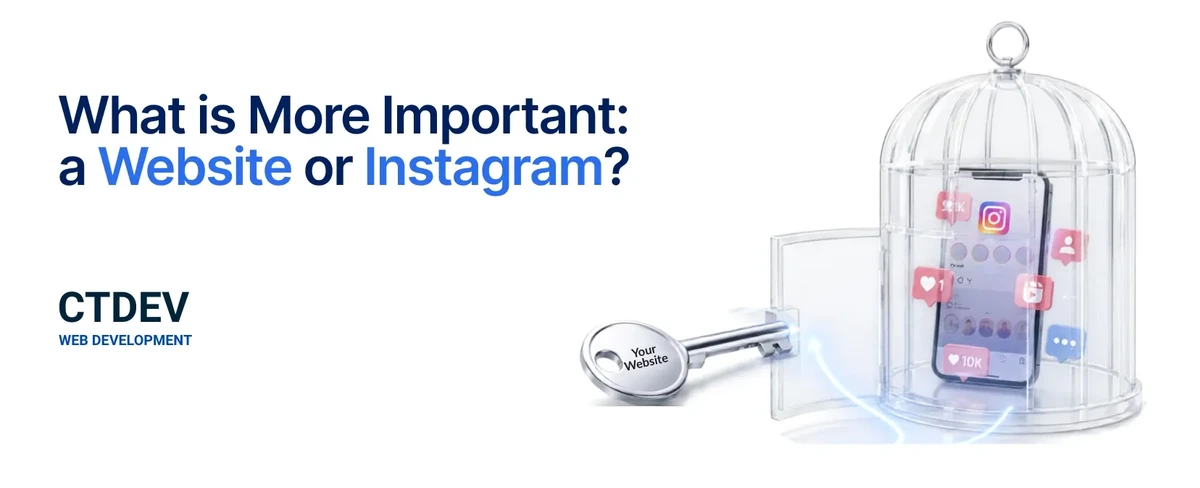
Imagine two people: a tenant and a homeowner. The tenant has a beautiful apartment, lovely furniture, and a great landlord. But the landlord can change the locks, hike the rent, or sell the building whenever they like. The homeowner? The house might be smaller, but they own it. They can paint the walls neon green, build an extension, and nobody can kick them out.
That’s the difference between social media and a website.
When you build your entire online presence on Instagram, Facebook, or TikTok, you’re a tenant. The platform is the landlord. You’ve decorated your rented space with content, gathered friends inside it, and started to feel at home. But you don’t hold the deed.
Meta owns Instagram. They decide:
- Who sees your posts (the algorithm)
- What order content appears in (no longer chronological)
- Whether your content gets suppressed (shadowbanning, policy changes)
- Whether your account gets suspended (one false flag, one copyright complaint)
- Whether the platform even exists in five years (ask anyone who built their presence on Vine or Google+)
A website is the house you own. It lives on a piece of digital land with your name on it. You control what’s on the page, how it looks, how fast it loads, and whether it’s available. No one can suspend your account. No one can shut you down because a policy changed. Your website stays standing, exactly as you left it, open for visitors 24/7.
What Happens When the Algorithm Changes
Here’s what most people don’t realize: the algorithm isn’t a stable system. It’s a tool designed to maximize the platform’s revenue — not yours.
Instagram’s organic reach collapse. In 2018, Instagram’s organic reach for accounts was roughly 16%. That meant about 16% of your followers saw any given post. By 2024, that number had dropped below 2%. If you have 2,000 followers, fewer than 40 of them see your post — unless you pay to boost it.
The shift to Reels. When Instagram pivoted hard toward Reels in 2022, accounts that built their following on static photo posts saw their reach plummet overnight. Beautiful, well-crafted photo content that used to perform brilliantly was buried. The platform decided video was the future, and people who didn’t adapt were left behind — through no fault of their own.
Facebook’s slow decline. Facebook’s organic reach has been falling for a decade. A page that once reached most of its fans for free now reaches a tiny fraction. Meta’s answer is always the same: pay for ads.
This isn’t just a feeling — it’s measurable. Take a baker who built her entire customer base through Instagram Stories. When reach dropped, so did her orders — by 60%, practically overnight. A fitness coach whose client pipeline depended on daily Reels suddenly found his views cut in half, with no explanation. If 80% of your customers come through Instagram and Meta cuts your reach by 90%, that isn’t a tech problem. It’s a revenue crisis.
These aren’t rare horror stories. They’re the normal, recurring pattern of social media platforms. The rules change, your reach drops, and the only way to recover is to spend more money — on ads, on content production, on chasing whatever format the algorithm currently favors.
Now, to be clear: a website isn’t immune to algorithms either. Google’s search algorithm decides which sites appear in results, and rankings can shift. But here’s the crucial difference: a website is a hub, not a single channel. Traffic comes from Google, from direct visits, from word of mouth, from your Instagram bio link. If Google’s algorithm shifts and your search ranking dips, you still have direct traffic, referrals, and your email list. But if Instagram is your only presence and the algorithm changes? You have nothing. One channel, zero fallback.
What You Actually Control on Social Media (Spoiler: Not Much)
Let’s be precise about what you own when your presence lives on Instagram:
Your follower count — Meta can delete followers (bot purges) or suppress your account at any time.
Your content — The platform can flag, remove, or demonetize posts without notice.
Your reach — Controlled entirely by the algorithm — not by content quality.
Your account — Can be suspended, hacked, or locked with little recourse.
Your customer relationships — You can’t export a list of followers. If the account dies, those contacts are gone.
Now compare that to a website:
Your content — Everything — no one removes or flags it.
Your visitor experience — Page speed, layout, navigation, messaging — all yours.
Your traffic sources — Multiple paths to find you — search, direct visits, referrals, social links.
Your data — Full analytics, visitor data, email signups — you own it all.
Your customer list — Email subscribers, contact form submissions — yours forever, exportable.
The difference is stark. On social media, you’re a guest in someone else’s house. On your website, you’re home.
What a Website Gives You That Instagram Never Will
1. People with buying intent can find you.
This is the single biggest advantage, and it’s the one people underestimate most.
Instagram shows your content to people who already follow you — people scrolling for entertainment, killing time between tasks. To reach new people, you either need viral content (unreliable) or paid ads (expensive).
Google works differently. When someone in your city searches “best hairdresser near me” or “reliable plumber in [your town]” or “wedding photographer [city],” they’re not browsing. They have a problem right now and they want to hire someone to solve it. That’s buying intent, and it’s worth far more than a double-tap from a follower who’s just scrolling.
If you have a website, you can appear in those results. If you don’t, you simply don’t exist for that search — and that customer hires whoever does show up.
2. You own your audience — not just access to it.
This one keeps people up at night once they realize it: you can’t export your Instagram followers. If your account gets suspended tomorrow, those 2,000 people are gone. You can’t email them. You can’t reach them. You start from zero.
On a website, you can collect email addresses through a signup form or contact form. That list is yours — you can export it, move it, use it however you want. No platform can cut you off from it. Even if every social platform changed its rules tomorrow, you’d still have a list of real people who want to hear from you.
3. Full control of how you present yourself.
Instagram forces you into a rigid format: square photos, short captions, a bio limited to 150 characters, a single link. Your pricing is in a post from three months ago. Your best testimonial is buried in Stories that expired. Your process explanation is scattered across captions that scrolled away.
A website puts everything in one permanent, organized place — a pricing page, a gallery, a detailed “how we work” section, customer reviews, a contact form, FAQs. Your best content doesn’t scroll away into oblivion. It stays exactly where people can find it, for as long as you want it there.
4. A permanent address that never changes.
Your Instagram handle could become irrelevant. Platforms rise and fall. But your domain name — yourname.com — is yours for as long as you renew it (about $12 a year). It goes on your cards, your van, your storefront window, your email signature. It’s a stable, professional front door that builds trust.
5. No daily feeding required.
Social media demands constant attention. Stop posting for two weeks and your reach collapses. The algorithm punishes inactivity. It’s a treadmill that never stops — a permanent tax on your time.
A website works for you 24/7 without daily effort. Once it’s built and optimized, it sits there — fast, reliable, findable — bringing in inquiries while you sleep, while you’re on a job, while you’re on vacation. It’s a one-time investment that keeps paying dividends for years.
”But My Customers Find Me on Instagram”
Yes — and that’s great. Instagram is genuinely excellent for one thing: discovery. It’s where people get a feel for your personality, see your work, and decide whether they like you. The visual, casual nature of Instagram is perfect for that.
But Instagram is terrible at the other thing: closing.
A website is a showcase — a place where you clearly and competently tell people what you do and why they should choose you. Social media is an excellent platform for warming up your audience and sharing daily updates, but giving a full picture of what you do there is nearly impossible.
Think of it like fishing. Instagram is brilliant bait — it catches attention, shows off your personality, and gets people interested. But a hook without a net loses a lot of fish. When a potential customer is curious enough to want to know more, where do they go? If they have to DM you, wait for a reply, and piece together what you offer and how much it costs, you’ve just added friction. In that pause, they might scroll away and forget about you entirely.
A website is the net. It catches that interest and gives it one place to land: your services, your prices, your availability, your location, your testimonials. It’s where trust gets built and decisions get made.
Here’s how it should work together:
- Social media = the bait. You attract attention, show your personality, and build a following.
- Your website = the net. You send interested people to your site for details, pricing, reviews, and to actually book.
The smartest people use both. They post on Instagram to stay visible and top-of-mind, then drive traffic to their website with a link in their bio, in their stories, in their captions. The website does the heavy lifting of converting interest into a booking.
Choosing between social media and a website is a false choice. You need both. But if you can only invest in one, invest in the one you own.
The Cost of Waiting
Here’s the part that’s hard to hear.
Every month you don’t have a website, people in your area are Googling for the service you provide. “Plumber near me.” “Wedding photographer in [city].” “Best bakery in [town].” And every single time, Google shows them your competitors — the ones who do have websites.
Put it in concrete terms. Imagine a kitchen fitter in a medium-sized town. Every day, maybe five to ten people search for “kitchen fitter near me.” None of them find him because he only has an Instagram page that doesn’t rank in Google. Instead, they find a competitor with a simple, clean website that shows past work, a contact form, and a phone number. Even if only one of those searches turns into a job each month, over a year that’s twelve jobs lost. If the average job is worth a few thousand, the cost of waiting isn’t theoretical — it’s real money left on the table.
For a café, it’s passing trade that Googled “coffee near me” and never knew you existed. For a therapist, it’s people in distress searching late at night who need someone to talk to right now, not tomorrow morning when you finally check your DMs.
These are high-intent searches. These people aren’t browsing. They have a problem and they want a solution. They’ll click the first result that looks credible, read the page, and make a call. If you’re not in the results, that customer goes to someone else. Not because they’re better than you — just because they showed up and you didn’t.
A website isn’t a vanity project. It’s how people who need you right now find you.
The Two Work Better Together
Let’s be clear: this isn’t about abandoning Instagram. It’s about giving it a partner.
Social media is where you whisper, “Hey, I exist, and I’m worth paying attention to.” Your website is where you prove it. One without the other is like having a shop with a gorgeous window display but no door — or a beautiful shop interior that no one can find down a dark alley.
When someone finds you on Instagram, they often have a few flickering seconds of curiosity. If you can send them to a website that loads fast, looks professional, and gives them exactly what they need — your story, your prices, a way to book — you’ve made it effortless for them to become a customer. That’s the whole game.
What to Do Next
If you’ve read this far, you already sense that relying entirely on rented ground might be riskier than it feels day to day. The good news is that building a website is far simpler and more affordable than it was five years ago.
Here’s the practical path forward:
- Don’t abandon social media. Keep posting. Keep engaging. It’s still your best tool for building awareness and personality.
- Get a website. Even a simple, fast, professional one-page site is infinitely better than nothing. It gives you a permanent address, a place to send people for details, and a presence on Google.
- Connect the two. Put your website link in your Instagram bio. Mention it in your stories. Add it to your email signature. Let social media feed your website, and let your website close the deal.
If you’re wondering about the options — Wix, Squarespace, hiring a developer — we’ve written an honest comparison that breaks down the pros, cons, and real costs of each path: Wix vs Squarespace vs Hiring a Developer.
And if you want a website that loads instantly, costs nothing to host, and never needs maintenance, that’s exactly what we build. Take a look at our landing page service to see how it works.
A website isn’t a magic wand, but it is a foundation. It gives you a permanent address in a world of temporary rentals. It’s the place your Instagram followers go when they’re ready to take the next step, and the place strangers find you when they need you most. You don’t need to choose between social media and a website — you just need to own your corner of the internet. Once you do, every post, every reel, and every recommendation has somewhere solid to point to.