TL;DR
- People are increasingly asking AI tools like ChatGPT, Google AI, and Perplexity for recommendations instead of searching Google — and if your website isn’t easy for AI to read, you won’t be recommended.
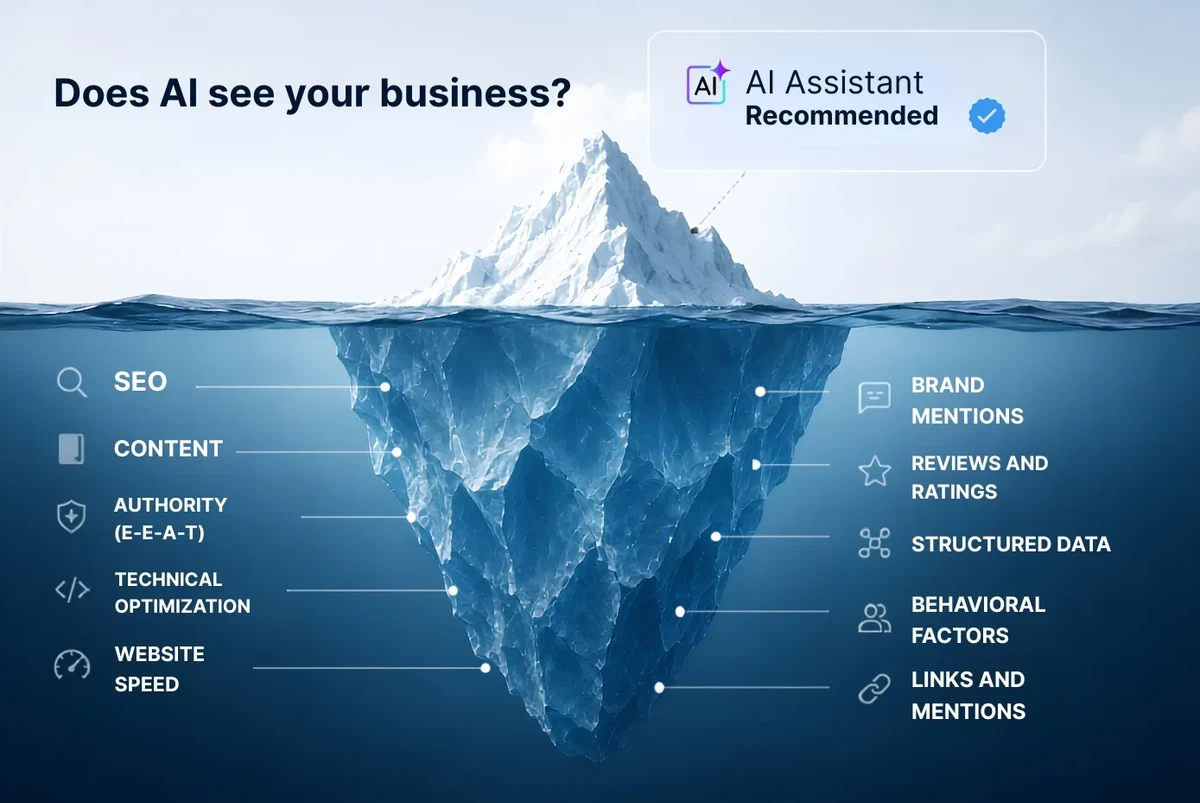
- AI tools recommend the people and services they can find, understand, and trust — based on clear website content, mentions on other sites, reviews, and how fast your pages load.
- You can’t pay to appear in AI recommendations (yet) — but you can make your website easy for AI to understand by writing specific, clear content about what you do and where.
- This is similar to traditional SEO but for a new kind of search. The basics overlap: clear content, fast pages, and being mentioned elsewhere still matter.
The Moment You Realize You’re Invisible
Someone asks ChatGPT “Who’s a good plumber in Austin?” The AI responds with a few names — names it pulled from the internet. Yours isn’t one of them. Meanwhile, your competitor with the worse website but clearer information gets the recommendation. How does AI decide who to recommend?
What AI Search Actually Is
When you type a question into ChatGPT, Google AI, Gemini, or Perplexity, you’re not searching the web the way Google works. You’re asking an AI that has read large portions of the internet and can answer in plain language.
These tools read websites, understand what people do, and recommend the ones that best match the question. Instead of getting a list of links to click through, you get a direct answer with names, explanations, and context.
This is different from traditional search — where you type keywords and scan through pages of results. With AI search, you ask a question and get an answer. The people mentioned in that answer are the ones the AI found, understood, and trusted enough to recommend.
Related: Why Your Website Isn’t on Google — traditional SEO is still the foundation. Getting on Google and getting recommended by AI overlap heavily.
How AI Finds and Recommends You
AI tools discover people the same way humans do: by reading what’s on the internet about you. The more clear, specific, and consistent information exists about you online, the more likely AI is to recommend you.
What AI reads: Your website’s text — what services you offer, where you’re located, who you help, what makes you different. Reviews on Google, Yelp, and other platforms. Mentions of your name on other websites, directories, and social media.
What AI values: Clarity over cleverness. An AI doesn’t care about your beautiful animations or clever taglines — it cares about whether your website clearly says “we are a plumber in Austin, Texas, serving these neighborhoods, offering these services.” Specificity wins.
What AI Looks For (5 Factors)
1. Clear, specific website content
Your website must clearly state what you do, where you’re located, and who you serve. AI reads your text to understand whether you match someone’s question.
Good: “We are a family-owned plumbing company serving South Austin since 2015. We specialize in emergency repairs, water heater installation, and drain cleaning.” — This is AI-readable. It contains what, where, and specificity.
Bad: “Quality service at affordable prices” — This tells AI nothing. It could be a plumber, a dentist, or a car wash.
2. Descriptive page titles and descriptions
Every page on your website has a title (the text that appears in a browser tab) and a description (a summary search engines and AI read). If these are missing or generic — “Home,” “About,” “Welcome” — AI has to guess what the page is about, and it usually guesses badly.
This is the same factor that matters for Google SEO. The basics overlap. When your page titles and descriptions clearly describe what’s on the page, both Google and AI tools understand you better.
3. Mentions on other websites
AI, like Google, trusts people who are mentioned on other websites. If you appear on Google Business Profile, Yelp, local directories, industry associations, and news articles, AI treats you as more established and trustworthy.
This is the same principle as backlinks in traditional SEO — but for AI, it’s also about being mentioned in context, not just linked to. An article that says “we hired this company to fix our plumbing and they were great” is gold for AI recommendations. The AI reads the sentence, understands what the company does, and files it away for the next time someone asks.
4. Reviews and ratings
AI tools read reviews to understand what customers think of you. Someone with 47 Google reviews and a 4.8-star rating is more likely to be recommended than someone with 3 reviews and no rating.
Reviews also give AI context. Phrases like “fast response time,” “fair pricing,” “professional” — these help AI match you to specific questions. If someone asks ChatGPT for a “reliable plumber with fair pricing,” your reviews are where that match is made.
5. Fast-loading, accessible pages
AI tools read your website the same way search engines do — by sending automated programs to download and read your pages. If your site is slow or hard to read by automated tools, AI may skip it or get incomplete information.
Fast-loading pages with clean, well-structured content are easier for AI to process. This is another factor that overlaps with traditional SEO — what’s good for Google is good for AI.
Related: Why Your Website Is Always Online — speed and accessibility benefit both human and AI visitors. A fast site loads quickly for everyone.
What You Can Do Right Now
You don’t need to hire anyone to start improving your AI visibility today. Here are the practical steps:
Write specific content. Every page should say what you do, where you are, and who you help. Replace “quality service” with “emergency plumbing repairs in South Austin.” The more specific you are, the better AI can match you to relevant questions.
Get your Google Business Profile in order. This is the #1 thing AI reads. Fill out every field — services, hours, service area, photos. Get reviews. A complete, active profile signals to AI that you’re real and active.
Get listed on directories. Yelp, Bing Places, industry-specific directories. Each listing is another place AI finds you. Most are free; some charge a fee.
Get reviews. Ask happy customers to leave reviews on Google. Reviews give AI confidence and context. A steady stream of recent reviews signals that you’re active and trusted.
Make your website fast. If your pages take 5 seconds to load, AI tools may time out before reading your content. A simpler, faster website is easier for AI to read — and better for your human visitors too.
Related: Why Your Website Doesn’t Need to Be Complicated — simpler, faster websites are easier for AI to read and recommend.
The Honest Limits
AI recommendations change constantly. No one can guarantee that ChatGPT will recommend you for a specific query. Anyone who promises “guaranteed AI placement” is selling something dishonest.
AI tools use different models, update their training data at different times, and may give different answers to different users. Your goal is not to “game” AI — it’s to make yourself easy to find, understand, and trust.
The factors in this post are based on what we know about how AI processes web content. The field is new and evolving. What works today may change. But the fundamentals — clear content, being mentioned elsewhere, having reviews — are unlikely to change because they’re the same signals humans use to decide who to trust.
How This Differs from Traditional SEO (and How It’s the Same)
What’s the same: Both reward clear content, fast pages, mentions on other sites, and reviews. Both penalize vague, thin, or broken websites. If you’ve been investing in SEO, you’re already doing most of what AI search rewards.
What’s different: Traditional SEO gives you a list of links. AI search gives a direct answer with names and explanations. With AI, being specifically mentioned in the answer matters more than ranking #3 on a list of links.
What’s different: AI tools can synthesize information across multiple sources — they might combine your website content, your reviews, and a blog post about you to form a recommendation. This means your presence across the entire web matters, not just your website.
30-Second AI Visibility Checklist
Before you close this tab, answer these five questions:
- My website clearly states what I do, where I’m located, and who I serve (not just “quality service”)
- I have a complete Google Business Profile with services, hours, photos, and reviews
- I appear on at least 2–3 other websites (Yelp, directories, industry listings)
- I have 10+ Google reviews with specific, descriptive text
- My website loads in under 3 seconds (test at pagespeed.web.dev)
If you checked “no” on two or more, you have fixable gaps that are keeping you out of AI recommendations. The good news: you now know exactly what they are.
FAQ
Can I pay to get recommended by ChatGPT?
No. AI search tools like ChatGPT, Google AI, and Perplexity don’t currently sell placement in their recommendations. Unlike Google Ads (where you pay to appear at the top of search results), AI recommendations are based on what the AI finds and understands about you. This may change in the future, but today, the only way to appear is to have clear, specific, trustworthy information online.
How is this different from regular SEO?
Regular SEO (getting found on Google) and AI search optimization overlap heavily — both reward clear content, fast pages, and mentions on other sites. The difference is the output: Google gives you a list of links, while AI gives a direct answer with names and explanations. Being cited by AI often requires being mentioned in context (e.g., a blog post describing working with you) rather than just having a link. Traditional SEO is covered in depth here →
Do I need a website to show up in AI search?
It helps enormously. While AI can find you through reviews and directory listings alone, a website gives AI the richest, most detailed source of information about what you do, where you are, and why someone should choose you. A Google Business Profile with no website is like a storefront with no sign — people can find you, but they can’t learn much about you.
How long does it take for AI to start recommending me?
There’s no fixed timeline. AI tools update their understanding at different intervals. If you improve your website content today, it may take weeks or months for AI tools to reflect those changes. The same is true for new reviews or directory listings. This is a long-term strategy, not an overnight fix — much like traditional SEO.
Bottom Line
AI search isn’t replacing Google — it’s adding another way people find you. The ones who get recommended are the people with clear, specific, trustworthy information online, both on their website and across the web. The fundamentals haven’t changed: say what you do, say where you are, get reviews, be fast, and be mentioned in the right places.
Want to show up when people ask AI for recommendations? Our AI Optimization service makes your website easy for AI to find, read, and recommend. Ready to get started? Get a quote →